6 Continents, 1 Job: How I Traveled the World Without Missing a Deadline
6 Continents, 1 Job: How I Traveled the World Without Missing a Deadline
In 2024, I set foot on 6 continents. Europe, Asia, Africa, North America, South America, and Australia. Different time zones, different cultures, unreliable WiFi in some places, and the constant temptation to just close the laptop and go explore.
And through all of it, I didn't miss a single deadline. Didn't drop the ball on a project. Didn't become that consultant who's "traveling" but actually just unavailable.
This isn't a humble brag. It's proof that remote work — real remote work, not just "work from home" — is possible if you approach it the right way. But it doesn't happen by accident. It takes discipline, flexibility, and a routine you can adapt to any location.
My Setup: Solo Consultant, Two Clients
Let me be upfront about my situation: I work as a solo developer and consultant for two clients. No team meetings. No standups. Most communication happens asynchronously through messages and project management tools.
This gives me a lot of flexibility that someone in a traditional remote job might not have. I'm not expected to be online at specific hours — as long as the work gets done and clients are happy, how I structure my day is up to me.
But that freedom is also a responsibility. There's no team to pick up slack if I fall behind. If I miss a deadline, there's no one to blame but myself. The flexibility that makes travel possible can also be the thing that derails you — if you don't have discipline.
The Core Problem: You're Not on Vacation
This is the mindset shift that took me a while to internalize.
When you're traveling and working, you're not on vacation. You're living your normal life in a different location. The work still needs to get done. The deadlines don't care that you're in Bangkok or Mexico City or Buenos Aires.
But you're also surrounded by once-in-a-lifetime experiences. That temple you've always wanted to see. That food market everyone talks about. That hiking trail with views you'll never forget.
The tension between "I need to work" and "I'm only here once" is real. And if you don't have a strategy for managing it, one of two things happens:
- You sacrifice the travel experience and spend the whole trip stressed in your accommodation
- You sacrifice the work and come back to a mess of missed deadlines and unhappy clients
Neither is acceptable. The goal is to do both well.
My Daily Rhythm: Mornings Are for Deep Work
After a lot of experimentation, I've settled into a routine that works almost anywhere.
Mornings are for real work. This is when I tackle the substantial tasks — building features, fixing complex bugs, writing documentation, anything that requires focus. I wake up, get coffee, and work for a solid 3-4 hours before the day really begins.
By late morning or noon, the heavy lifting is done. I've made progress. I've moved things forward. The rest of the day belongs to me.
Afternoons are for quick pop-ins. Client message that needs a response? A small bug that takes 20 minutes to fix? A quick review of something? These don't need a dedicated work block. I handle them as they come, wherever I am. Laptop in a cafe, on a park bench, on the train — doesn't matter.
Evenings are for exploring and relaxing. By this point, the work is handled. I can wander the streets, find a good restaurant, catch a sunset, or just decompress without that nagging feeling that I should be working.
This rhythm works because it front-loads the demanding work. Once the morning block is done, everything else is just maintenance.
Flexibility Goes Both Ways
Here's the thing about routines: they need to bend, not break.
Some experiences only happen in the morning. That famous market that closes at noon. The temple that's packed by 10am. The wildlife that's only active at dawn. The hiking trail you need to start early to finish before dark.
When there's a morning attraction I don't want to miss, I flip the schedule. Do the tourist thing in the morning, then handle work in the evening. Not the deep, complex work — I save that for proper morning focus — but the smaller tasks, the things that don't require peak mental energy.
The key is planning this in advance. I know what's on my work plate for the week. I know which days have flexibility and which don't. When I see that the best time to visit somewhere is Tuesday morning, I make sure Tuesday's work is the kind that can shift to evening.
I Actually Love Distractions
You'll read a lot of advice about finding quiet, distraction-free environments to work. Noise-canceling headphones. Facing the wall. Pretending you're in an office.
That's not me.
I genuinely don't mind distractions. If I'm sitting at a cafe with a beautiful view, people walking by, life happening around me — I can still focus on the task at hand. If anything, I find sterile, isolated environments more draining than energizing.
This makes the "quick pop-in" approach work well for me. I don't need to find the perfect working spot to handle a 20-minute task. I can pull out my laptop almost anywhere, knock something out, and get back to whatever I was doing.
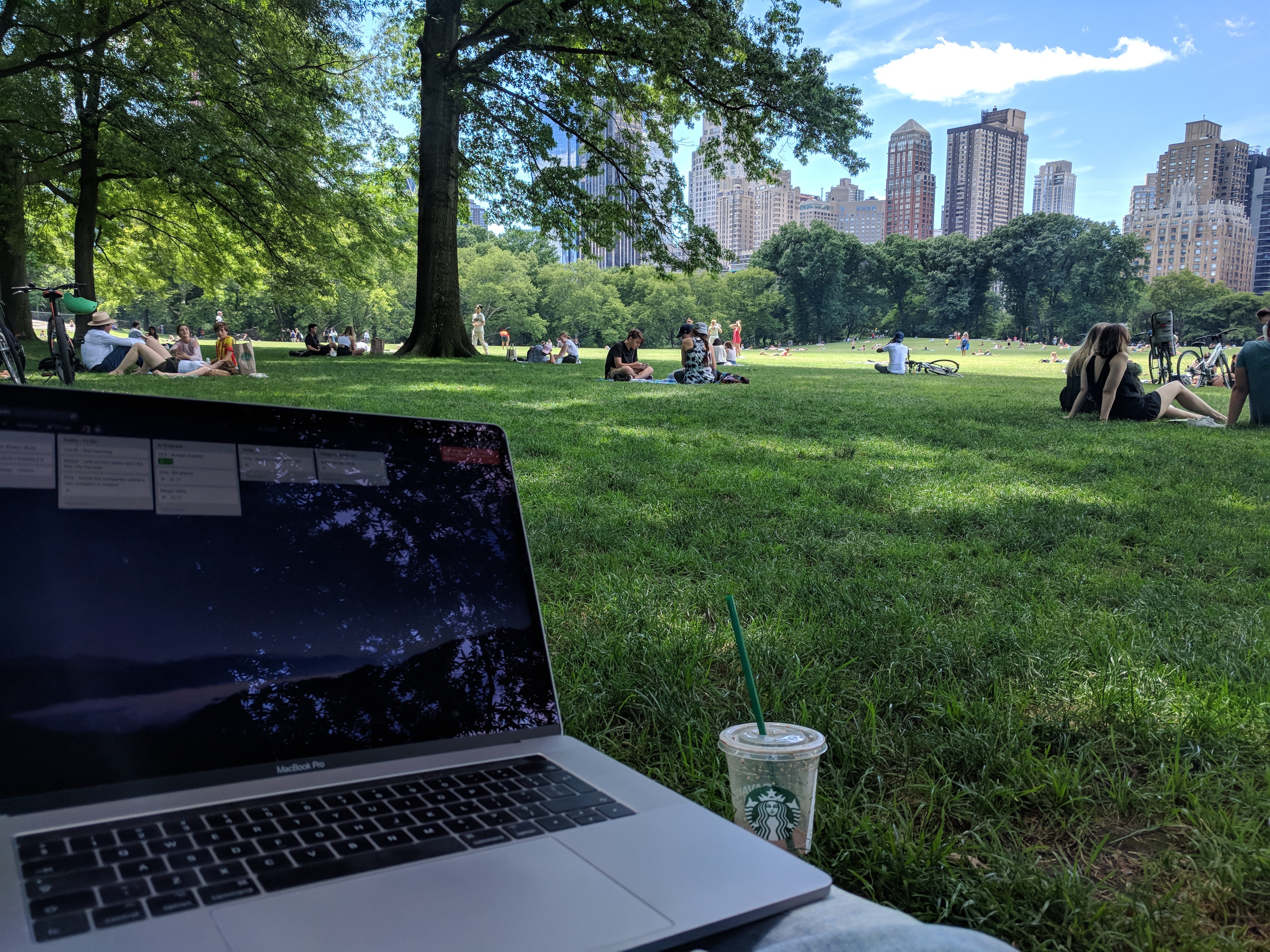 - New York City - Central Park
Not everyone works this way, and that's fine. But if you're someone who thrives in stimulating environments rather than quiet ones, don't force yourself into the "serious remote worker" aesthetic. Work the way you actually work best.
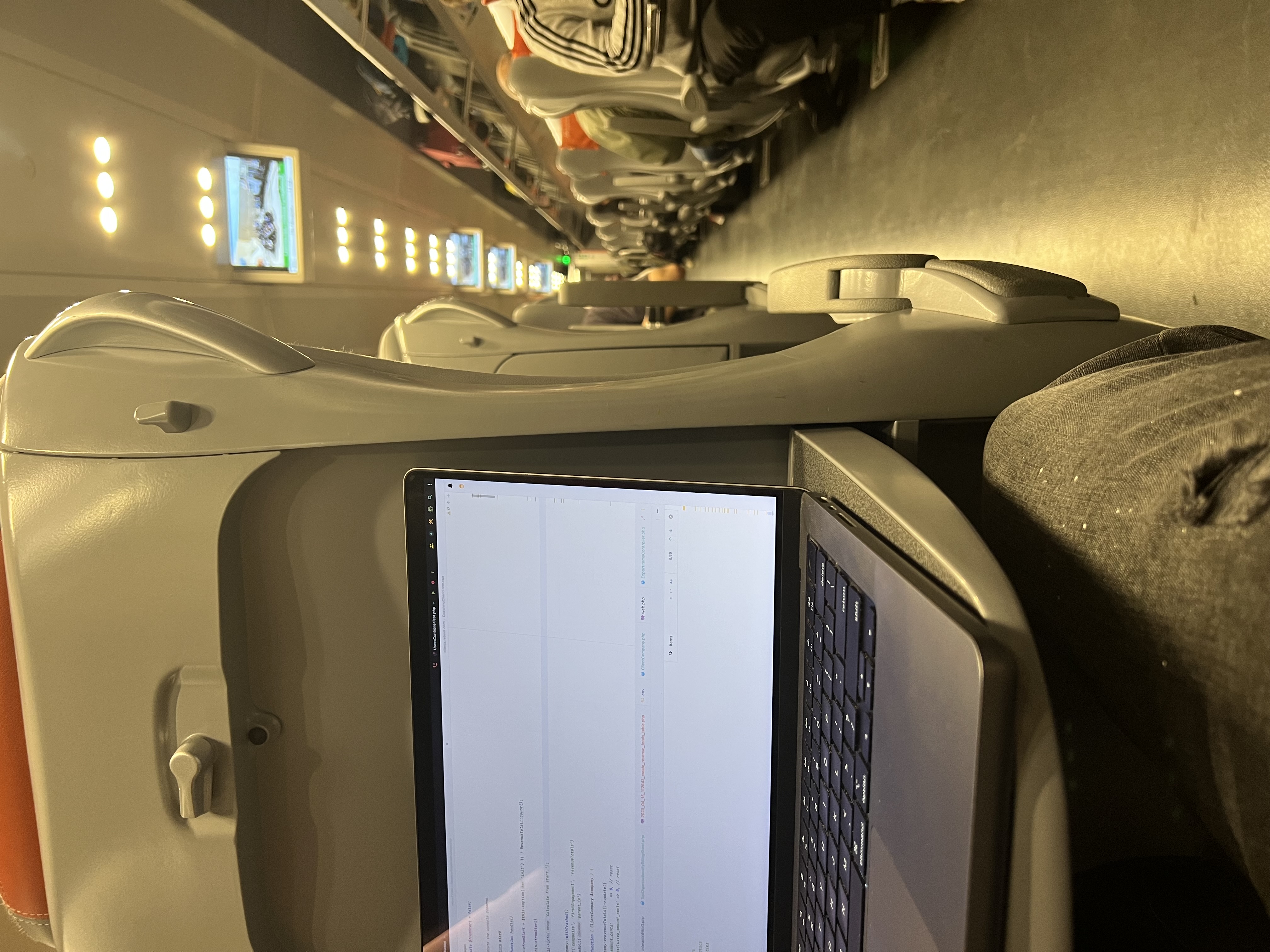 - on a train from Rome to Naples
The WiFi Problem
This one will bite you if you're not careful.
I've been in Airbnbs with "high-speed WiFi" that couldn't load a Git diff. I've been in cafes where the connection dropped every 10 minutes. I've been in entire neighborhoods where mobile data was barely functional.
My rules now:
Always have a backup. Local SIM card with data, or an international eSIM. If the WiFi fails, I can hotspot from my phone. This has saved me more times than I can count.
Test the connection early. When I arrive somewhere new, I test the WiFi immediately. Can I push code? Can I access everything I need? If not, I find alternatives before it becomes urgent.
Know your options. Coworking spaces, hotel lobbies, certain cafe chains — I identify backup spots on day one, even if I never use them.
Communicate proactively. If I'm heading somewhere with questionable connectivity (a safari, a remote island, a long train ride), I let my clients know in advance. "I'll be offline from X to Y. Here's where things stand."
Client Management as a Solo Consultant
Working with two clients while traveling requires clear communication and realistic expectations — mostly expectations I set with myself.
Over-deliver on communication. I send updates before clients ask for them. "Here's what I finished today, here's what I'm working on tomorrow, here's anything I need from you." This builds trust that I'm on top of things, regardless of where I am geographically.
Don't overpromise. When I'm traveling, I'm honest with myself about capacity. I don't take on ambitious new projects or tight deadlines during heavy travel periods. I focus on steady, reliable delivery.
Buffer your estimates. Travel introduces uncertainty. Flights get delayed. You get sick from street food. The WiFi situation turns out worse than expected. I build buffer into my timelines so these hiccups don't turn into crises.
Be reachable, but set boundaries. My clients know they can reach me if something's urgent. They also know I'm not monitoring messages 24/7. Finding this balance took time, but it's essential for sustainable travel.
Energy Management Matters
Here's something I didn't expect: traveling is tiring.
Even when you're having the time of your life, the constant novelty is exhausting. New places, new languages, new food, new navigation challenges. Your brain is working overtime just to exist in an unfamiliar environment.
This is why the morning work block is so important. I'm freshest then. By evening, after a day of exploring and stimulation, I'm not operating at full capacity — and I don't pretend otherwise.
When I'm on the road, I'm realistic about what I can accomplish. I don't schedule ambitious refactoring projects or tasks that require deep creative thinking. I focus on well-defined work where I know exactly what needs to be done.
The exploratory, high-creativity work? I save that for when I'm settled somewhere for a longer stretch.
Longer Stays Make Everything Easier
Speaking of longer stretches — this made a huge difference.
Early in my travel experiments, I tried moving fast. New city every 3-4 days. It was exciting but unsustainable. By the time I figured out where to get coffee, where the WiFi worked, how to navigate the neighborhood, I was packing up again.
Now I aim for minimum one week in each location, preferably two. This gives me time to:
- Find my rhythm in the new place
- Discover the reliable working spots
- Get the tourist highlights done without rushing
- Have "normal" days where I just work and live, without the pressure to see everything
The trip becomes less frantic. The work becomes more sustainable. And honestly, you experience places more deeply when you're not racing through them.
What I've Learned
A few principles that emerged from couple of years of doing this:
Your routine is portable. The specific location doesn't matter as much as having a consistent approach. Morning work, afternoon pop-ins, evening exploration — this works whether I'm in Lisbon or Melbourne or Medellín.
Flexibility is a feature, not a bug. The ability to shift things around based on what's happening — an unmissable morning attraction, an unexpected client need — is what makes this sustainable. Rigid schedules break under travel pressure.
Know yourself. I know I work best in the morning. I know I don't mind distractions. I know I need evenings free to feel like I'm actually experiencing a place. Your version might look different, and that's fine.
Communication covers a multitude of sins. When clients know what you're doing, and when to expect things, they're remarkably understanding about non-traditional work arrangements.
Was It Worth It?
Six continents. Dozens of cities. Experiences I'll remember for the rest of my life.
And not a single "sorry I dropped the ball while I was traveling" conversation.
The remote work revolution promised us freedom — freedom to work from anywhere, to design our own lives, to break the connection between income and location. But freedom doesn't happen automatically. It has to be earned through discipline and smart planning.
If you're thinking about traveling while working, my advice is simple: know your rhythm, be honest about your capacity, communicate clearly with clients, and remember that you're not on vacation — you're just living your life somewhere more interesting.
The world is waiting. Your deadlines are too. With the right approach, you can honor both.